Invocation to Patanjali
Chanting transforms the yoga experience by grounding students in tradition, enhancing both personal and communal awareness, and guiding the practitioner inward toward reflection and deeper connection.
Who Was Patanjali and When Were the Yoga Sūtras Written?
The Yoga Sūtras, traditionally attributed to the sage Patanjali *, were likely compiled sometime between 100 BCE and 400 CE. Scholars continue to debate both the precise timeline and who wrote them. Rather than a single historical figure, “Patanjali” may represent a lineage or school of thought, preserving and systematizing much older oral teachings that were already well established within Indian philosophical traditions.
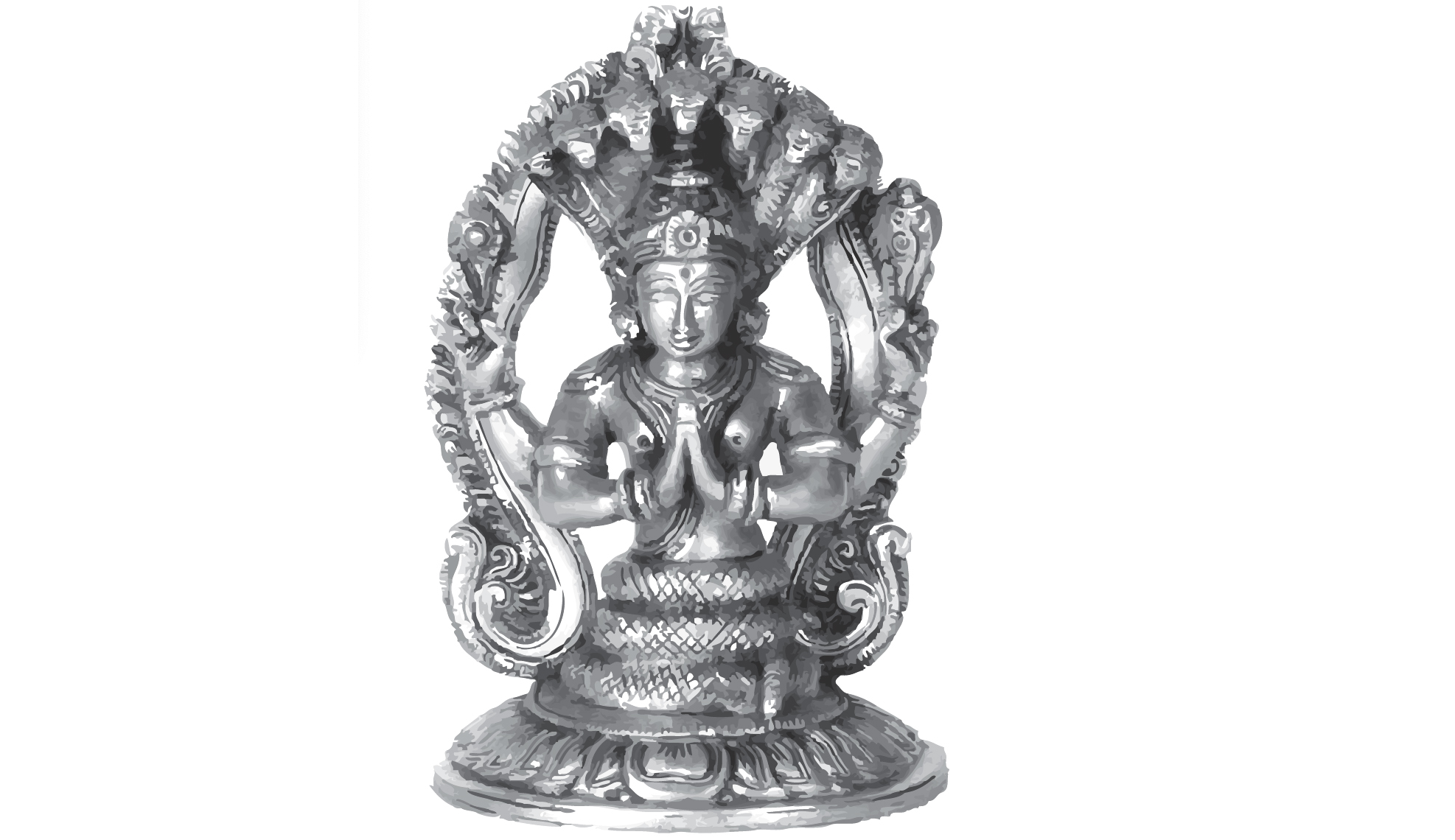
In the Iyengar Yoga tradition, however, Patanjali is honored for more than just compiling history, but as a divine incarnation of Adiśeṣa, the cosmic serpent on whom Lord Vishnu rests, Patanjali is often depicted as a semi-divine being: human from the waist up, with a serpent’s tail below, sheltered by a seven-hooded cobra. He holds symbolic objects representing wisdom, protection, and continuity of knowledge.
This symbol directly inspires the Invocation to Patanjali, chanted at the beginning of Iyengar Yoga classes. The chant honors Patanjali as the sage who perfected yoga (mind), grammar (speech), and medicine (body). Sometimes referred to as the “three Patanjalis.” In this way, Patanjali becomes a core symbolic figure for a holistic path, integrating clarity of mind, precision of language, andhealth of the body.
Not One, but Possibly Three Patanjalis
Ancient tradition often blends multiple figures into a single revered sage. Besides the Patanjali of the Yoga Sūtras, other historical figures named Patanjali wrote on Sanskrit grammar and Ayurveda. In traditional belief, one great sage reached perfection in body, mind, and speech.
Modern scholars generally see them as different people with the same name, later brought together through respect and myth. This reflects how Indian traditions value the passing on of wisdom more than focusing on individual lives.
What Are the Yoga Sūtras?
The YogaSūtras consist of 196 concise Sanskrit aphorisms, organized into four chapters(pādas). Together, they present an integrated system of yogic practice centered on the eightfold path (aṣṭāṅga yoga), which includes:
- Ethical restraints (yama)
- Observances (niyama)
- Posture (āsana)
- Breath regulation (prāṇāyāma)
- Withdrawal of the senses (pratyāhāra)
- Concentration (dhāraṇā)
- Meditation (dhyāna)
- Absorption (samādhi)
Very different from modern studio yoga, the YogaSūtras are mainly a guide for training the mind, offering practical ways to develop clarity, stability, and inner freedom.
Their Timeless Goal
At their core, the Yoga Sūtras provide a clear and systematic approach to quietinghabitual mental patterns through ethical living, disciplined practice, andmeditation.
The ultimate aim is liberation from suffering (kaivalya). Their relevance has endured for centuries, inspiring countless teachers,practitioners, and translators across cultures and generations.
The Importance of Chanting to Patanjali in Iyengar Yoga
In Iyengar Yoga, chanting the Invocation to Patanjali before class serves several essential purposes that enrich the practice:
• Honoring Tradition: Chanting pays respect to Patanjali, grounding practitioners in the historical and philosophical roots of yoga.
• Enhancing Focus and Intention: The act of chanting centers the mind and clarifies intention, creating a purposeful beginning to practice.
• Cultivating Mindfulness: Chanting reduces mental noise, encourages present-moment awareness, and fosters a calm, receptive state.
• Creating a Sacred Space: As a ritual, chanting marks the transition from daily life into practice, inviting reverence and attention.
• Fostering Community: In group settings, chanting unifies participants, strengthening collective energy and mutual support.
• Invoking Positive Energy: The vibrations of sound evoke specific emotional and mental states, aligning practitioners more deeply with their intentions.
Final Thougths
I find that chanting before class, even if it’s just the sound of "Aum,"helps create a moment of separation from the outside world and prepares me for practice.
It facilitates going inward and quieting my breath. Additionally, chanting with others is a beautiful experience; the vibrations of the sound resonate deeply.We not only tune into ourselves but also connect with the energy of the roomand the people around us.
However,not everyone enjoys chanting, or practices it at all, and that is completely okay. We can have personal mantras that we keep to ourselves and don’t share with others. We may chant Aum silently, just for ourselves, or choose not to chant at all. No mantras, just the breath. Whatever works for you as an individual and supports your personal practice is valid.
*The word Patanjali means ‘fallen into folded hands’, from ‘pat’, tofall, and ‘anjali’, hands folded in reverence.
Lise is the founder of vayamyoga in Bern, Switzerland.She is a dedicated yoga practitioner and a certified Iyengar Yoga Instructor(Level 1).
Deutsche Version
Anrufung an Patanjali
Das Singen von Mantras verändert die Yoga-Erfahrung, indem es die Übenden in der Tradition verankert, sowohl das persönliche als auch das gemeinsame Bewusstsein stärkt und den Praktizierenden nach innen zu Reflexion und tieferer Verbindung führt.
Wer war Patanjali und wann wurden die Yoga-Sutras geschrieben?
Die Yoga-Sutras, die traditionell dem Weisen Patanjali* zugeschrieben werden, wurden vermutlich zwischen 100 v. Chr. und 400 n. Chr. zusammengestellt. Forschende diskutieren noch immer sowohl über die genaue Zeitspanne als auch über den Autor. „Patanjali“ könnte weniger eine einzelne historische Figur, sondern vielmehr eine Linie oder Schule von Lehrenden sein, die ältere mündliche Überlieferungen bewahrten und systematisierten, die in den indischen Philosophietraditionen bereits fest verankert waren.
In der Iyengar-Yoga-Tradition wird Patanjali jedoch nicht nur als Sammler von Wissen geehrt. Als göttliche Inkarnation von Adishescha, der kosmischen Schlange, auf der Lord Vishnu ruht, wird Patanjali oft als halb-göttliches Wesen dargestellt: vom Bauch aufwärts menschlich, darunter mit einem Schlangenschwanz, geschützt von einer siebenköpfigen Kobra. Er hält symbolische Gegenstände, die Weisheit, Schutz und Kontinuität des Wissens repräsentieren.
Dieses Symbol inspiriert direkt die Anrufung an Patanjali, die zu Beginn der Iyengar-Yoga-Stunden gesungen wird. Die Anrufung ehrt Patanjali als Weisen, der Yoga (Geist), Grammatik (Sprache) und Medizin (Körper) vollendet hat, manchmal als die „drei Patanjalis“ bezeichnet. So wird Patanjali zu einer zentralen symbolischen Figur für einen ganzheitlichen Weg, der Klarheit des Geistes, Genauigkeit der Sprache und Gesundheit des Körpers vereint.
Nicht einer, sondern vielleicht drei Patanjalis
Früher wurden in alten Traditionen oft mehrere Personen zu einem einzigen verehrten Weisen zusammengefasst. Neben dem Patanjali, der die Yoga-Sutras schrieb, gab es andere historische Persönlichkeiten namens Patanjali, die über Sanskrit-Grammatik und Ayurveda schrieben. Man glaubte, dass ein grosser Weise Vollkommenheit in Körper, Geist und Sprache erreichen konnte.
Moderne Forschende sehen sie meist als verschiedene Personen mit demselben Namen, die später aus Respekt und durch Geschichten zusammengebracht wurden. Das zeigt, dass in indischen Traditionen die Weitergabe von Wissen wichtiger ist als das Leben einer einzelnen Person.
Was sind die Yoga-Sutras?
Die Yoga-Sutras bestehen aus 196 prägnanten Sanskrit-Aphorismen, die in vier Kapitel (Padas) gegliedert sind. Zusammen bilden sie ein integriertes System der yogischen Praxis, das auf den acht Gliedern des Yoga (Ashtanga-Yoga) basiert.
1. Ethische Regeln (Yama)
2. Disziplin / Selbstbeobachtung (Niyama
3. Körperhaltungen (Asana)
4. Atemkontrolle (Pranayama)
5. Rückzug der Sinne (Pratyahara)
6. Konzentration (Dharana)
7. Meditation (Dhyana)
8. Versenkung / Einheitsbewusstsein (Samadhi)
Anders als modernes Studio-Yoga dienen die Yoga-Sutras vor allem als Leitfaden für das Training des Geistes und bieten praktische Wege, Klarheit, Stabilität und innere Freiheit zu entwickeln.
Ihr zeitloses Ziel
Im Kern geben die Yoga-Sutras eine klare, systematische Anleitung, um gewohnheitsmässsige Gedankenmuster durch ethisches Leben, disziplinierte Praxis und Meditation zur Ruhe zu bringen.
Das ultimative Ziel ist Befreiung vom Leiden (kaivalya). Ihre Bedeutung ist über Jahrhunderte geblieben und hat viele Lehrende, Yogapraktizierende und Übersetzende über Kulturen und Generationen hinweg inspiriert.
Die Bedeutung der Anrufung an Patanjali im Iyengar-Yoga
Im Iyengar-Yoga erfüllt die Anrufung an Patanjali vor der Stunde mehrere wichtige Aufgaben, die das Üben bereichern:
• Ehrung der Tradition: zeigt Respekt gegenüber Patanjali und verankert die Übenden in den historischen und philosophischen Wurzeln des Yoga.
• Fokus und Absicht stärken: zentriert den Geist und klärt die Absicht, wodurch ein bewusster Start in die Praxis entsteht.
• Achtsamkeit fördern: reduziert geistiges Rauschen, unterstützt Bewusstsein im gegenwärtigen Moment und erzeugt einen ruhigen, empfänglichen Zustand.
• Einen heiligen Raum schaffen: Als Ritual markiert es den Übergang vom Alltag zur Praxis und lädt zu Aufmerksamkeit und Ehrfurcht ein.
• Gemeinschaft stärken: In Gruppen verbindet das Chanten die Teilnehmenden, stärkt kollektive Energie und gegenseitige Unterstützung.
• Positive Energie hervorrufen: Die Schwingungen des Klangs erzeugen bestimmte emotionale und geistige Zustände und vertiefen die Ausrichtung auf die eigene Absicht.
Abschliessende Gedanken
Ich erlebe, dass die Anrufung vor der Stunde, selbst wenn es nur der Klang „Aum“ ist, einen Moment der Abgrenzung von der Aussenwelt schafft und mich auf die Praxis vorbereitet.
Es hilft, nach innen zu gehen und den Atem zu beruhigen. Zudem ist der Gesang mit anderen eine wunderschöne Erfahrung; die Schwingungen des Klangs resonieren tief. Wir stimmen uns nicht nur auf uns selbst ein, sondern verbinden uns auch mit der Energie des Raumes und der Menschen um uns herum.
Allerdings mögen nicht alle die Anrufung oder den Gesang, und das ist vollkommen in Ordnung. Wir können persönliche Mantras haben, die wir für uns behalten und nicht teilen. Wir können „Aum“ still für uns singen oder ganz darauf verzichten. Keine Mantras, nur der Atem. Alles, was für dich als Einzelperson funktioniert und deine Praxis unterstützt, ist gültig.
Lise ist die Gründerin von vayamyoga in Bern, Schweiz. Sie ist eine engagierte Yogaschülerin und zertifizierte Iyengar-Yoga-Lehrerin (Level 1).
The Invocation to Patanjali - Anrufung des Patanjali
Om - Om - Om
yogena cittasya padena vācām
malaṁ śarīrasya ca vaidyakena
yopākarottaṁ pravaraṁ munīnāṁ
patañjaliṁ prāñjalirānato’smi
ābāhu puruṣākāraṁ
śaṅkha cakrāsi dhārinam
sahasra śirasam śvetam
praṇamāmi patañjalim
Hari Om
EN:
Let us bow to the noblest of sages, Patanjali, who gave yoga for the serenity and sanctity of the mind, grammar for clarity and purity of speech, and medicine for the perfection of the body.
Let us prostrate before Patanjali, an incarnation of Adhiśeṣa, whose upper body has a human form, whose arms hold a conch and a disc, and who is crowned by a thousand-headed cobra.
DE:
Lasst uns vor dem edelsten aller Weisen, Patanjali, niederbeugen, der Yoga schenkte, um den Geist zu beruhigen und zu heiligen, Grammatik, um die Sprache zu klären und zu reinigen, und Heilkunde, um den Körper zu vollenden.
Lasst uns Patanjali anbeten, eine Inkarnation von Adhiśeṣa, dessen Oberkörper menschliche Gestalt hat, dessen Arme eine Muschel und eine Scheibe halten, und der von einer tausendköpfigen Kobra gekrönt ist.
Bonus
By Dr. Geeta Iyengar:
In the Iyengar Yoga tradition, AUM (OM) is the primordial, supreme sound that represents the source of all creation and consciousness. Chanting it serves as an auspicious beginning and invocation for yoga practice, helping to sanctify the mind and heart and invite inner focus and unity before beginning the physical and subtle aspects of yoga. The three syllables A, U, and M represent the full range of consciousness (waking, dreaming, and deep sleep), and the sound itself aligns the practitioner with the universal vibration and grace that supports deep, sincere practice.
References, Referenzen
Books:
• Bryant, Edwin F. The Yoga Sūtras of Patañjali: A New Edition, Translation, and Commentary with Insights from Traditional Commentators. New York: North Point Press, 2009.
• White, David Gordon. The Yoga Sutra of Patanjali: A Biography. Princeton: Princeton University Press, 2014.
• Iyengar, B.K.S. Light on the Yoga Sutras of Patanjali. (Publication info if available)
Edited Volumes / Academic Articles:
• Maas, Philipp A. “On the Written and Oral Transmission of the Pātañjalayogaśāstra.” In Yoga in Transformation: Historical and Contemporary Perspectives, edited by Karl Baier, Philipp A. Maas, and Karin Preisendanz. Vienna: Vienna University Press, 2018.
Online Resources:
• Internet Encyclopedia of Philosophy. “Yoga Sutras of Patanjali.” Accessed January 2026. https://iep.utm.edu/yoga/
• Iyengar Yoga. “Sage Patanjali.” https://bksiyengar.com/modules/iyoga/sage.htm
• Iyengar Yoga Centre Canada. The Patanjali Invocation. Accessed July 2014. https://iyengaryogacentre.ca/wp-content/uploads/2014/07/Patanjali-2.pdf
• Chestnut Hill Yoga. The Invocation to Patanjali and an Invitation to Sit for a Moment. https://chestnuthillyoga.com/home-practice-resources/the-invocation-to-patanjali-and-an-invitation-to-sit-for-a-moment-
• Meloni, David. The Patanjali Invocation by Geeta S. Iyengar. Accessed January 2026. https://www.davidiyengaryoga.it/en/articolo/dettaglio/