Invocation to Patanjali
Chanting transforms the yoga experience by grounding students in tradition, enhancing both personal and communal awareness, and guiding the practitioner inward toward reflection and deeper connection.
Who Was Patanjali and When Were the Yoga Sūtras Written?
The YogaSūtras, traditionally attributed to the sage Patanjali *, were likely compiled sometime between 100 BCE and 400 CE. Scholars continue to debate both the precise timeline and who wrote them. Rather than a single historical figure, “Patanjali” may represent a lineage or school of thought, preserving and systematizing much older oral teachings that were already well established within Indian philosophical traditions.
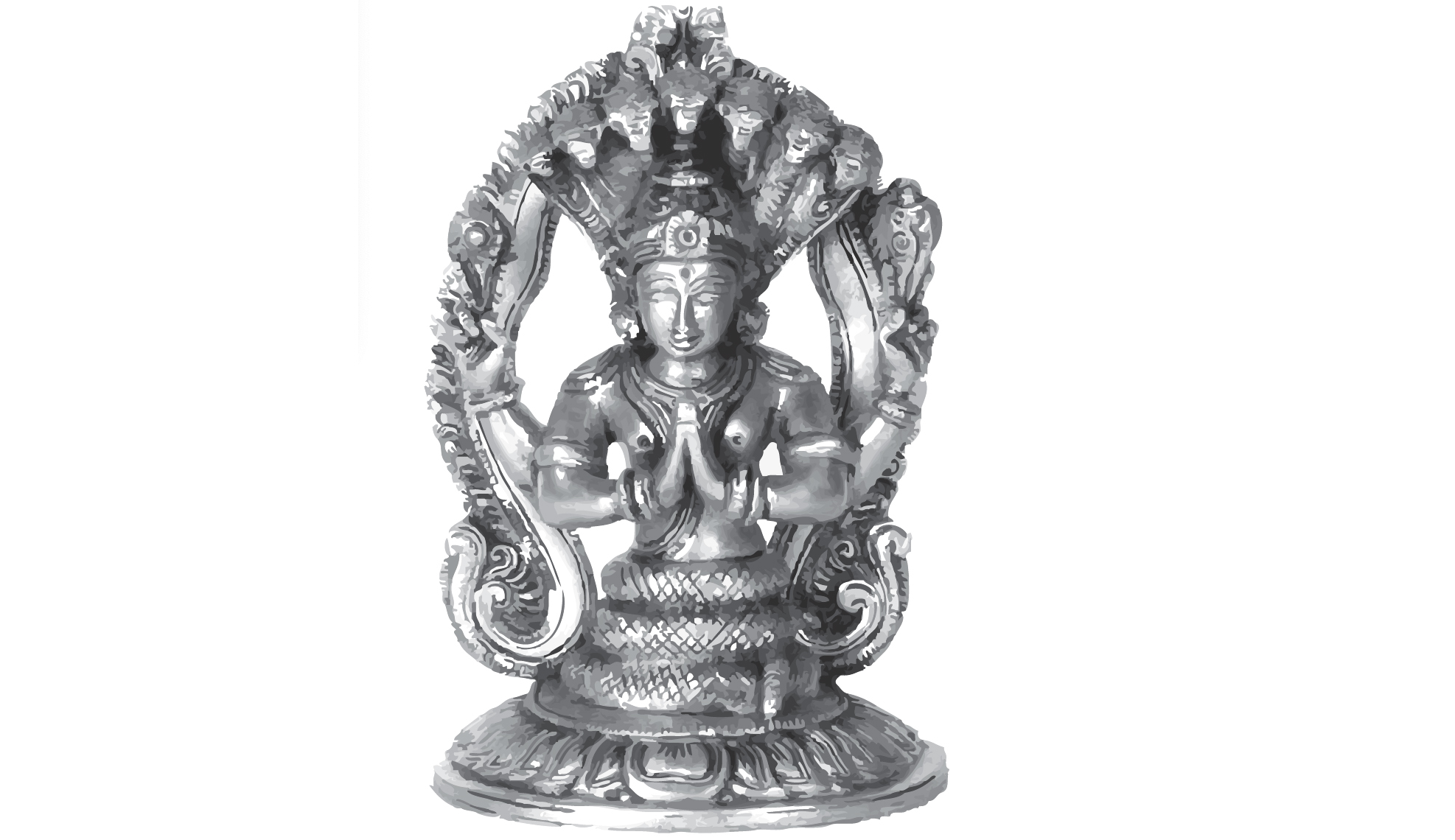
In the Iyengar Yoga tradition, however, Patanjali is honored for more than just compiling history, but as a divine incarnation of Adiśeṣa, the cosmic serpent on whom Lord Vishnu rests, Patanjali is often depicted as a semi-divine being: human from the waist up, with aserpent’s tail below, sheltered by a seven-hooded cobra. He holds symbolicobjects representing wisdom, protection, and continuity of knowledge.
Thissymbol directly inspires the Invocation to Patanjali, chanted at the beginningof Iyengar Yoga classes. The chant honors Patanjali as the sage who perfectedyoga (mind), grammar (speech), and medicine (body). Sometimes referred to asthe “three Patanjalis.” In this way, Patanjali becomes a core symbolic figurefor a holistic path, integrating clarity of mind, precision of language, andhealth of the body.
Not One, but possibly three Patanjalis
Ancienttradition often blends multiple figures into a single revered sage. Besidesthe Patanjali of the Yoga Sūtras, other historical figures named Patanjaliwrote on Sanskrit grammar and Ayurveda. In traditional belief, one great sagereached perfection in body, mind, and speech.
Modern scholars generally see them as different peoplewith the same name, later brought together through respect and myth. Thisreflects how Indian traditions value the passing on of wisdom more thanfocusing on individual lives.
What Are the Yoga Sūtras?
The YogaSūtras consist of 196 concise Sanskrit aphorisms, organized into four chapters(pādas). Together, they present an integrated system of yogic practice centeredon the eightfold path (aṣṭāṅga yoga), which includes:
- Ethical restraints (yama)
- Observances (niyama)
- Posture (āsana)
- Breath regulation (prāṇāyāma)
- Withdrawal of the senses (pratyāhāra)
- Concentration (dhāraṇā)
- Meditation (dhyāna)
- Absorption (samādhi)
Very different from modern studio yoga, the YogaSūtras are mainly a guide for training the mind, offering practical ways todevelop clarity, stability, and inner freedom.
Their Timeless Goal
At theircore, the Yoga Sūtras provide a clear and systematic approach to quietinghabitual mental patterns through ethical living, disciplined practice, andmeditation.
The ultimate aim is liberation from suffering (kaivalya). Theirrelevance has endured for centuries, inspiring countless teachers,practitioners, and translators across cultures and generations.
The Importance of Chanting to Patanjali in Iyengar Yoga
In Iyengar Yoga, chanting the Invocation to Patanjali before class serves severalessential purposes that enrich the practice:
- Honoring Tradition: Chanting pays respect to Patanjali, grounding practitioners in the historical and philosophical roots of yoga.
- Enhancing Focus and Intention: The act of chanting centers the mind and clarifies intention, creating a purposeful beginning to practice.
- Cultivating Mindfulness: Chanting reduces mental noise, encourages present-moment awareness, and fosters a calm, receptive state.
- Creating a Sacred Space: As a ritual, chanting marks the transition from daily life into practice, inviting reverence and attention.
- Fostering Community: In group settings, chanting unifies participants, strengthening collective energy and mutual support.
- Invoking Positive Energy: The vibrations of sound evoke specific emotional and mental states, aligning practitioners more deeply with their intentions.
Final thougths
I find that chanting before class, even if it’s just the sound of "Aum,"helps create a moment of separation from the outside world and prepares me forpractice.
Itfacilitates going inward and quieting my breath. Additionally, chanting withothers is a beautiful experience; the vibrations of the sound resonate deeply.We not only tune into ourselves but also connect with the energy of the roomand the people around us.
However,not everyone enjoys chanting, or practices it at all, and that is completelyokay. We can have personal mantras that we keep to ourselves and don’t sharewith others. We may chant Aum silently, just for ourselves, or choose not to chant atall. No mantras, just the breath. Whatever works for you as an individual andsupports your personal practice is valid.
*The word Patanjali means ‘fallen into folded hands’, from ‘pat’, tofall, and ‘anjali’, hands folded in reverence.
The Invocation to Patanjali - Anrufung des Patanjali
Om - Om - Om
yogena cittasya padena vācām
malaṁ śarīrasya ca vaidyakena
yopākarottaṁ pravaraṁ munīnāṁ
patañjaliṁ prāñjalirānato’smi
ābāhu puruṣākāraṁ
śaṅkha cakrāsi dhārinam
sahasra śirasam śvetam
praṇamāmi patañjalim
Hari Om
Translation:
Let us bow to the noblest of sages, Patanjali, who gave yoga for the serenity and sanctity of the mind, grammar for clarity and purity of speech, and medicine for the perfection of the body.
Let us prostrate before Patanjali, an incarnation of Adhiśeṣa, whose upper body has a human form, whose arms hold a conch and a disc, and who is crowned by a thousand-headed cobra.
Bonus
By Dr. Geeta Iyengar:
In the Iyengar Yoga tradition, AUM (OM) is the primordial, supreme sound that represents the source of all creation and consciousness. Chanting it serves as an auspicious beginning and invocation for yoga practice, helping to sanctify the mind and heart and invite inner focus and unity before beginning the physical and subtle aspects of yoga. The three syllables A, U, and M represent the full range of consciousness (waking, dreaming, and deep sleep), and the sound itself aligns the practitioner with the universal vibration and grace that supports deep, sincere practice.
References, Referenzen
Books:
• Bryant, Edwin F. The Yoga Sūtras of Patañjali: A New Edition, Translation, and Commentary with Insights from Traditional Commentators. New York: North Point Press, 2009.
• White, David Gordon. The Yoga Sutra of Patanjali: A Biography. Princeton: Princeton University Press, 2014.
• Iyengar, B.K.S. Light on the Yoga Sutras of Patanjali. (Publication info if available)
Edited Volumes / Academic Articles:
• Maas, Philipp A. “On the Written and Oral Transmission of the Pātañjalayogaśāstra.” In Yoga in Transformation: Historical and Contemporary Perspectives, edited by Karl Baier, Philipp A. Maas, and Karin Preisendanz. Vienna: Vienna University Press, 2018.
Online Resources:
• Internet Encyclopedia of Philosophy. “Yoga Sutras of Patanjali.” Accessed January 2026. https://iep.utm.edu/yoga/
• Iyengar Yoga. “Sage Patanjali.” https://bksiyengar.com/modules/iyoga/sage.htm
• Iyengar Yoga Centre Canada. The Patanjali Invocation. Accessed July 2014. https://iyengaryogacentre.ca/wp-content/uploads/2014/07/Patanjali-2.pdf
• Chestnut Hill Yoga. The Invocation to Patanjali and an Invitation to Sit for a Moment. https://chestnuthillyoga.com/home-practice-resources/the-invocation-to-patanjali-and-an-invitation-to-sit-for-a-moment-
• Meloni, David. The Patanjali Invocation by Geeta S. Iyengar. Accessed January 2026. https://www.davidiyengaryoga.it/en/articolo/dettaglio/